
Testing AI-generated code: why green tests are not enough
Research on weak tests and false greens in AI coding benchmarks, what to verify beyond a passing suite, and a ticket where QA caught what specs missed.
On this page
- Why do green tests mean less for AI-generated code?
- What does the research say about weak tests and false greens?
- What is a false green, and why do AI agents produce them?
- What makes a test good enough for generated code?
- What should you verify beyond the passing suite?
- A real case: what caught what
- Which tools help test AI-generated code?
- How do you set this up for your team?
- Frequently asked questions
Short answer: Testing AI-generated code needs more than the test suite passing, because the suite itself is often the weakest link. Research on AI coding benchmarks found that patches counted as correct sometimes fail the very tests written for them, and that strengthening weak test suites flips the verdict on a meaningful share of examples. The practical setup that works: write tests against the ticket's acceptance criteria rather than trusting tests the author produced, have an agent that did not write the change review it, verify the result end-to-end against a running system, and attach the evidence — requests, output, screenshots — to the ticket where the work lives.
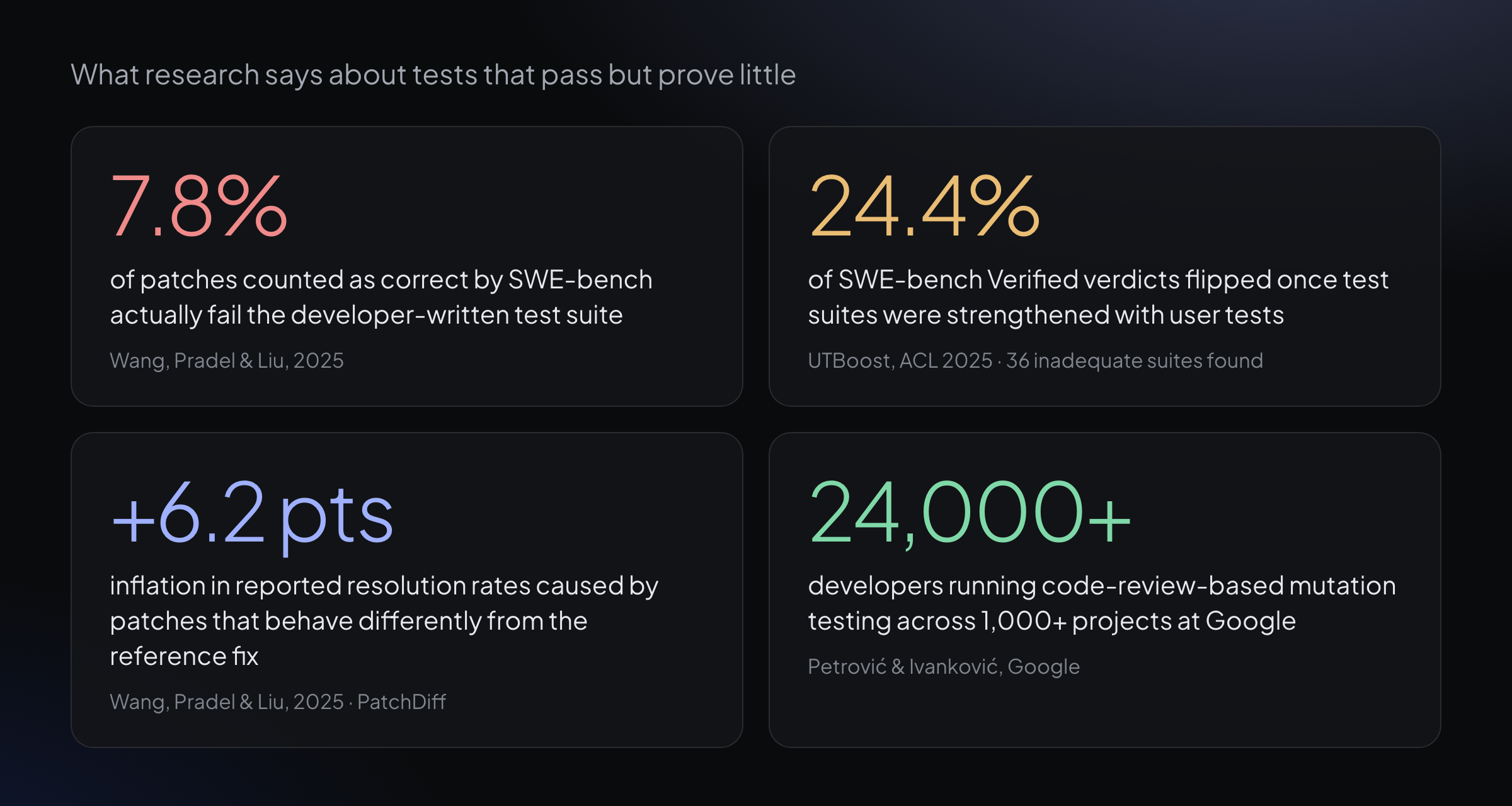
Four findings on tests that pass but prove little. Each study is linked in the sections below.
Why do green tests mean less for AI-generated code?
A passing test suite answers one narrow question: does the code behave the way these particular tests expect? It does not answer whether the tests were any good, whether they encode the same misunderstanding the code does, or whether the change does what the ticket actually asked.
With human-written code, experience teaches which of these risks matter. With AI-generated code, a new one joins the list: the author that produced the change can also produce tests for it, and both can be wrong in the same direction. The test asserts the buggy behaviour the implementation happens to have, the suite goes green, and the defect ships wearing a badge of verification.
The research on AI coding benchmarks quantified this precisely, and the numbers are the reason this article exists.
What does the research say about weak tests and false greens?
| Study | What was measured | Finding |
|---|---|---|
| Wang, Pradel & Liu, 2025 | Patches from three state-of-the-art issue-solving tools on SWE-bench Verified, re-checked with differential patch testing | 7.8% of patches counted as correct actually fail the developer-written test suite. 29.6% of plausible patches behave differently from the reference fix, and 28.6% of those were certainly incorrect on manual inspection. Reported resolution rates were inflated by 6.2 percentage points |
| UTBoost, ACL 2025 | Test suites on SWE-bench Verified, augmented with generated user tests | 36 task instances had inadequate test suites. Once the suites were strengthened, the verdict flipped on 24.4% of instances — the tests could not tell correct patches from broken ones |
| Petrović & Ivanković, Google | Mutation testing as a day-to-day practice, later run in code review across 24,000+ developers and 1,000+ projects | Mutation testing — deliberately breaking code to check that tests notice — is practical at industrial scale when results arrive as review comments rather than raw reports |
| DORA, 2024 | Survey-based model of software delivery performance | Higher AI adoption went with a 7.2% estimated drop in delivery stability — more AI output without stronger verification makes delivery less stable, not more |
The Wang, Pradel and Liu paper is the sharpest of the set. Its PatchDiff technique replays each candidate patch and the reference fix against the same inputs and compares behaviour, which catches the case that ordinary test suites miss: a patch that passes every test while implementing something subtly different from what was asked. Almost half of the divergent patches they examined were similar-but-divergent implementations — code that looks like the right fix and is not.
UTBoost attacked the other half of the problem: the tests themselves. Its generated user tests found whole test suites that could not distinguish a correct patch from an incorrect one. If a benchmark built and curated by the field itself has that weakness, a sprint branch has it worse.
What is a false green, and why do AI agents produce them?
A false green is a passing test that fails to constrain the code: it asserts less than the requirement, asserts the wrong thing, or duplicates the implementation's assumptions instead of the specification's.
Three mechanisms produce them disproportionately in AI-assisted work.
First, the author-writes-its-own-tests loop. When the same agent generates the change and its tests, the tests are downstream of the same reading of the requirement. If that reading is wrong, both are wrong consistently, and nothing in the run notices.
Second, the satisficing pull. An agent optimises toward the signals it can observe. A test that asserts too little turns green sooner than a test that asserts the full contract, and iteration pressure rewards sooner.
Third, the oracle problem, which is older than any of these tools: a test can only compare behaviour against some definition of correct. If that definition lives only in the implementer's head — or in the implementer's own generated test — the comparison proves nothing about the requirement.
What makes a test good enough for generated code?
Since the suite is the first gate, its quality decides everything downstream. A weak test and a strong test can both be green; only one of them is evidence. The difference is visible in what the assertions actually pin down.
| Weak assertion | Strong assertion |
|---|---|
expect(response.status).to eq(200) on an endpoint that should refuse unauthenticated callers |
The missing-key and invalid-key cases each assert the exact failure status and error body |
| Asserting a field exists in a payload | Asserting the field's value for a known input, plus the absent case |
| Testing only the happy path through a CLI command | Each failure path: no credentials, unreachable service, missing dependency — with exit codes |
| Tests generated from the diff after the code was written | Tests derived from the ticket's acceptance criteria before implementation details existed |
The left column is not a strawman; the benchmark research found entire suites in that style. The right column has one thing in common: each assertion would fail under a realistic break, which is the mutation-testing criterion in miniature. You do not need formal mutation tooling to apply it. For any test worth keeping, ask the one-question version: if this code were broken in the way the ticket fears, would this test notice?
The other practical habit is ordering. Tests derived from the brief, written before the implementation shapes the vocabulary, inherit the requirement instead of the code. Tests written afterwards tend to describe what was built — and when the builder is an agent that misread the brief, the description is precise, green, and wrong.
What should you verify beyond the passing suite?
The layers below overlap on purpose. Each one catches things the previous layer is blind to, and the last one is where most AI-coded changes actually break.
| Check | Catches | Blind to |
|---|---|---|
| Tests written against the ticket's criteria | Behavior that ignores what was actually asked | Whatever the brief did not name |
| Independent review — an agent that did not write the change | Cross-cutting invariants and similar-but-wrong implementations | Runtime behaviour on real data |
| Live verification, end-to-end | Integration gaps, error paths, environment reality | Nothing mechanical — but the evidence must be stored |
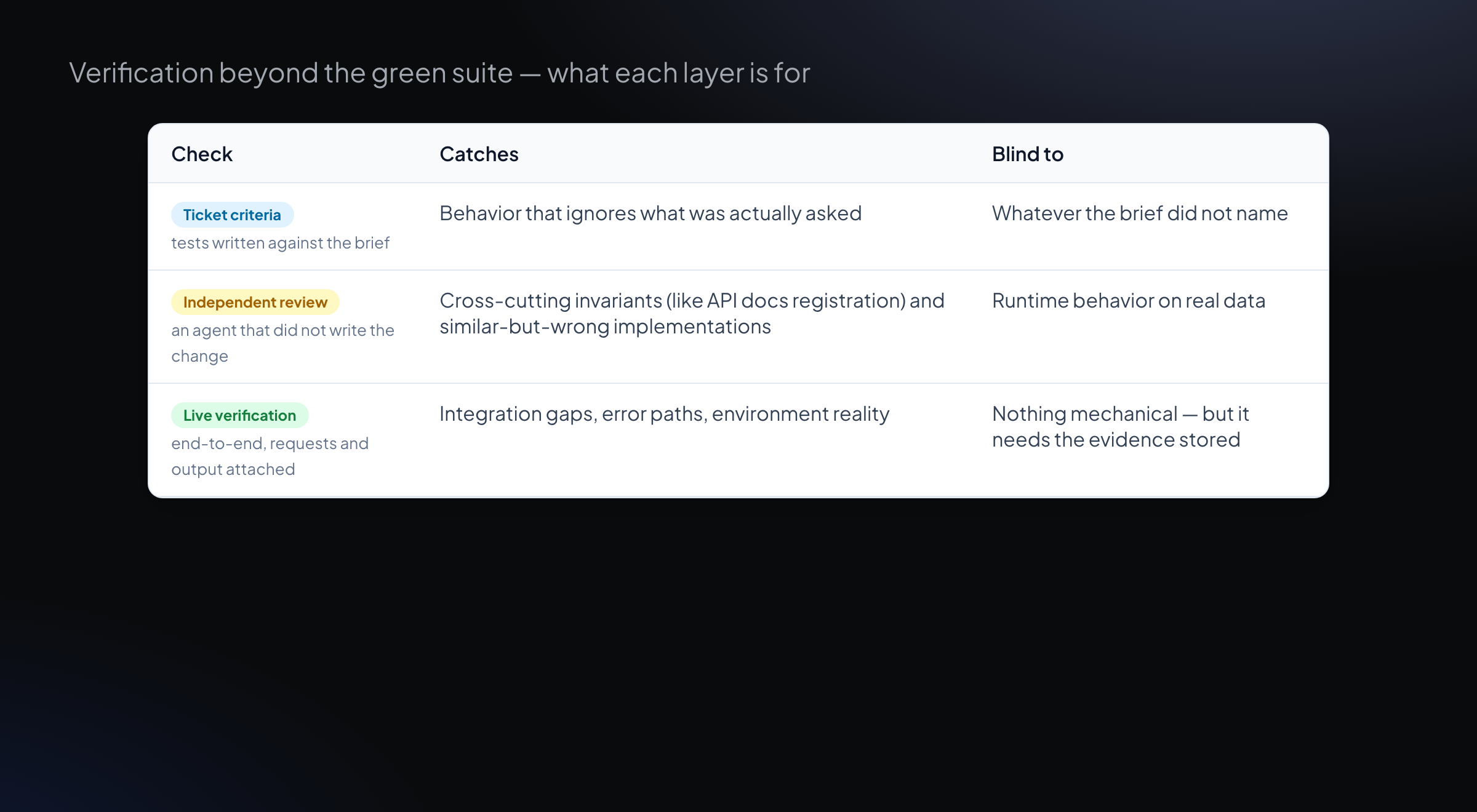
Three layers of verification. The table mirrors the checks that caught real defects in the case below.
Two of these deserve a note.
The independent review layer exists because of the invariants no single diff can see. In the case below, the failing check was not in the changed code at all: a repository-wide rule that every public API route carries a documentation entry. The change was locally perfect and globally wrong, and only a reviewing agent with the whole repository in scope could see it.
The live verification layer exists because environments lie less than mocks do. Error paths — missing credentials, unreachable services, missing dependencies — are exactly the code that unit suites stub away, and exactly where AI-generated CLI and API code tends to fail its users.
A real case: what caught what
Ticket YATFA-3370 in YATFA's own workspace asked for a small, well-bounded feature: a ps-style command-line listing of the agents running on a machine, merged with their server-side status. It shipped in two pieces — an API endpoint and the command that consumes it — and it passed through confirmation, review, rejection, rework, review again, QA, and approval, all on 8 July 2026, between roughly 05:00 and 13:00 UTC.
The review caught the thing the suite could not. The first submission passed the changed code's own tests. It failed review anyway — not on the new logic, but on a repository-wide invariant: every public API route must carry a documentation entry in a central registry, and the new route had none. The API docs page would have silently listed an endpoint with an empty description. One line fixed it, and the re-review re-ran the affected suites plus the full API suite — 538 examples, zero failures — to confirm nothing else had moved.
The QA phase then did what suites cannot: it ran both pieces against a live server. The QA pass built a dedicated fixture workspace with six agents plus a second workspace to prove cross-project isolation, then walked every acceptance criterion with real requests — missing key answered 401, an invalid key answered 401, responses validated field by field, the current-ticket field present for a busy agent and null for the rest, and availability left untouched by read-only calls. On the command-line side it exercised the real binary's failure paths: no configured key exits with a clear message, missing Docker exits with a clear message, an unreachable server degrades to a local-only table instead of a stack trace. The server log across all of it showed zero error lines.
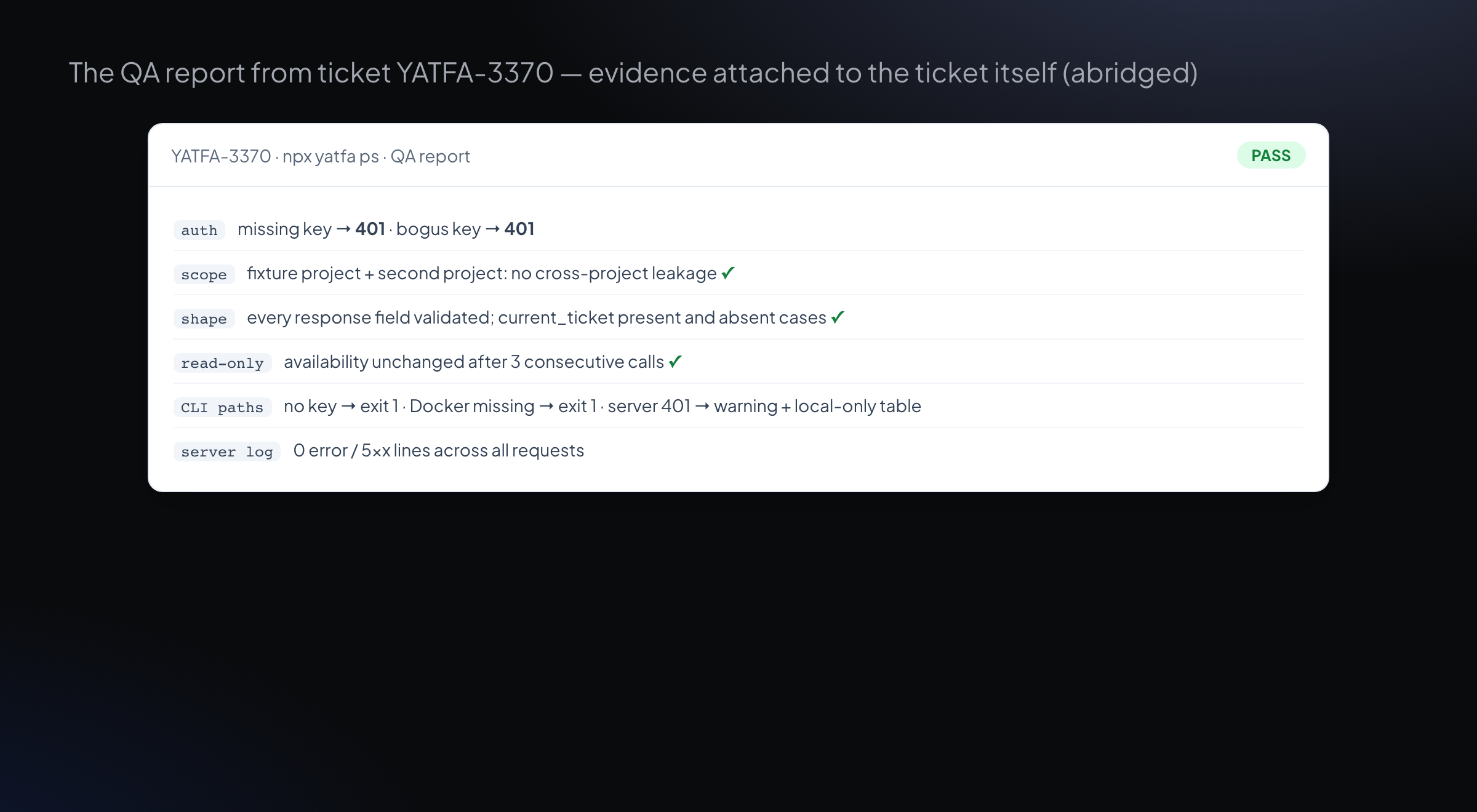
The QA report as it lives on the ticket, abridged. The full version, with the requests and output inline, is part of the work's permanent record.
Two details of that QA pass matter more than its verdict. First, the evidence lives on the ticket: the requests, the output, the zero-error log line — anyone auditing the change later reads the proof, not a claim of proof. Second, the QA pass disclosed its own environment honestly: Docker was not available in its sandbox, so the missing-Docker path was exercised through the real binary while only the two container-listing calls were simulated — and the report says exactly which. Evidence that states its own limits is what makes the green trustworthy.
Which tools help test AI-generated code?
| Tool or technique | What it does | Where it fits |
|---|---|---|
| UTBoost-style test augmentation | Generates additional user tests from the issue text to expose weak suites | Before trusting a suite, on benchmark or branch |
| Review-based mutation testing | Deliberately breaks code; uncaught mutants become review comments | Continuous, at code review |
| Differential patch testing (Wang et al.) | Replays candidate and reference fixes, compares behaviour | High-stakes changes with a known-good reference |
| End-to-end passes on a live system with evidence attached | Exercises error paths and integration the suite stubs away | The final gate, every change |
How do you set this up for your team?
The four steps below assume what the research implies: the suite is evidence only when it is built against the requirement and stress-checked for honesty. Everything else is configuration.
1. Tie every test to a named criterion
When work starts from a ticket, require the tests to trace to its acceptance criteria. A test the author cannot connect to a named requirement is checking an accident of implementation.
2. Never let the author's tests be the only tests
Whether the author is a person or an agent, add one verification that did not share the author's reading of the requirement: independent review, a second test author, or both.
3. Run the real thing, and keep the output
An end-to-end pass on a live or staging system — with the requests and responses attached to the ticket — catches the class of failure suites structurally cannot. Make the evidence part of the definition of done, not a heroics bonus.
4. Add mutation testing where the code matters most
Start with the modules where a silent defect is expensive, and let uncaught mutants surface as review comments, the way Google's teams run it. You do not need 100% mutation coverage; you need the suites around critical code to be honest.
5. Treat a flaky or weak suite as a defect
UTBoost found whole suites that could not fail a wrong patch. If a test cannot fail for a realistic break, fix or delete it — a weak test is unpaid debt in the exact place you will later need it.
Frequently asked questions
Do green tests mean AI-generated code is correct?
No. The SWE-bench research found patches that pass the official tests while behaving differently from the intended fix, and test-augmentation work flipped the verdict on roughly a quarter of examples once suites were strengthened. Green means the code matches the tests; only independent verification speaks to the requirement.
What is a false green in AI-generated code?
A test that passes while failing to constrain the behaviour it appears to check: it asserts too little, mirrors the implementation's mistakes, or was generated from the same misunderstanding as the code. The suite stays green and the defect ships.
How is testing AI-generated code different from testing human code?
The mechanisms of failure differ, not the principles. AI tools add the author-writes-its-own-tests loop and the satisficing pull toward assertions that pass sooner, so the independence of tests and review matters more, and mutation-style checks on critical suites pay off faster.
Do I need mutation testing for every repo?
No. Google's own results argue for the incremental version: mutation comments in code review, aimed first at the modules where a silent defect is most expensive. Broad, low-signal mutation runs burn time and teach teams to ignore the tool.
What evidence should an AI coding agent attach to its work?
Enough for someone else to audit the claim without re-running it: the commands executed, their output, test results with counts, and the live verification pass where one happened. Where a step could not run as designed — an unavailable dependency, a simulated call — the report says so explicitly, because evidence that hides its own limits is how a green checkmark becomes a liability. A verdict without attached evidence is a promise; with evidence, it is a record.
YATFA builds an engineering organization around AI coding agents: tests written against the ticket's criteria, review by an agent that didn't write the change, live QA with evidence attached to every ticket. See how YATFA verifies changes, read how to review AI-generated code, or start free.
Terms in this article
Keep reading
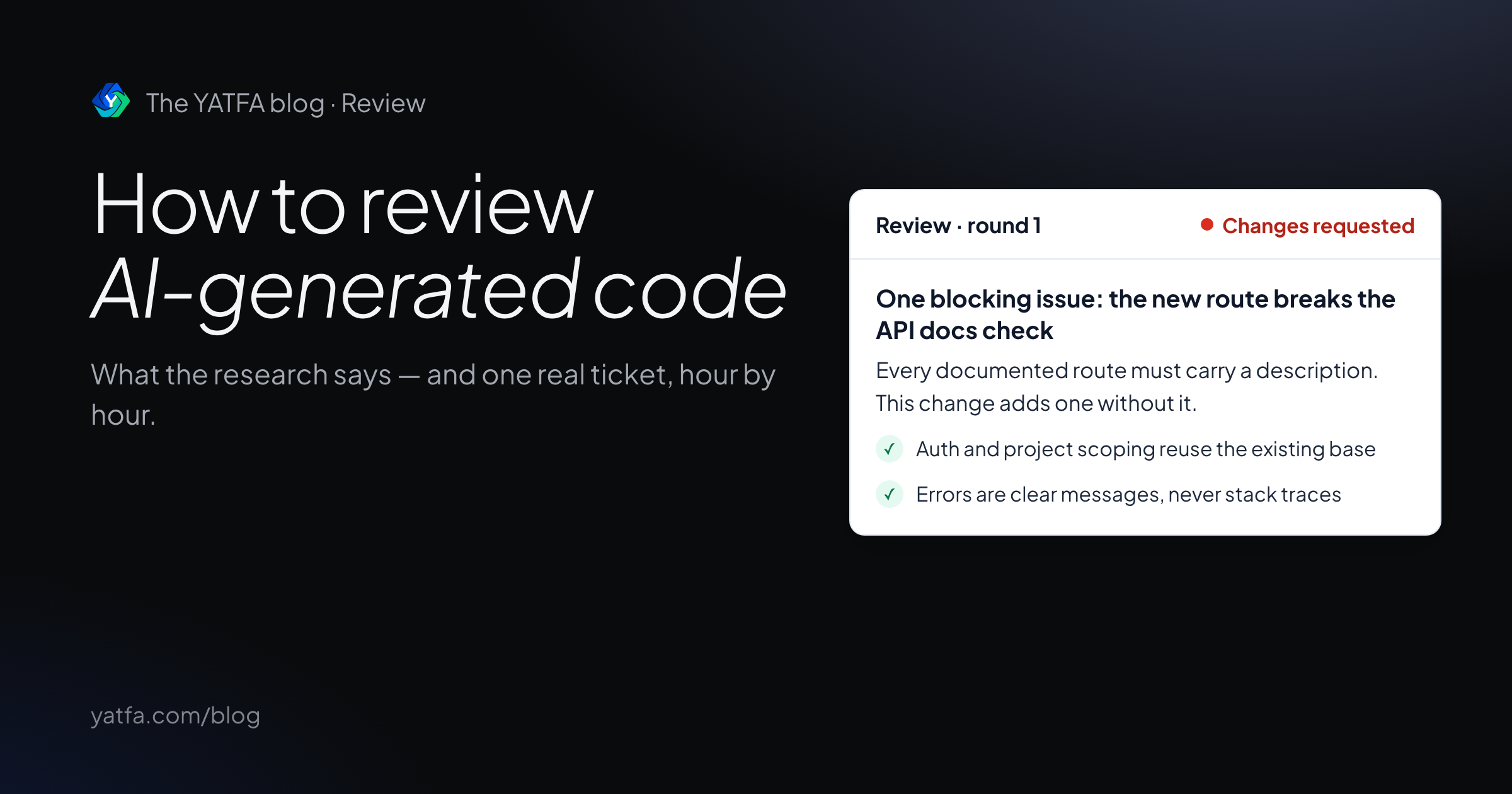
How to review AI-generated code
What five studies say about AI-written code, ten review practices with sources, a checklist, and one real ticket reviewed hour by hour.
Read the article →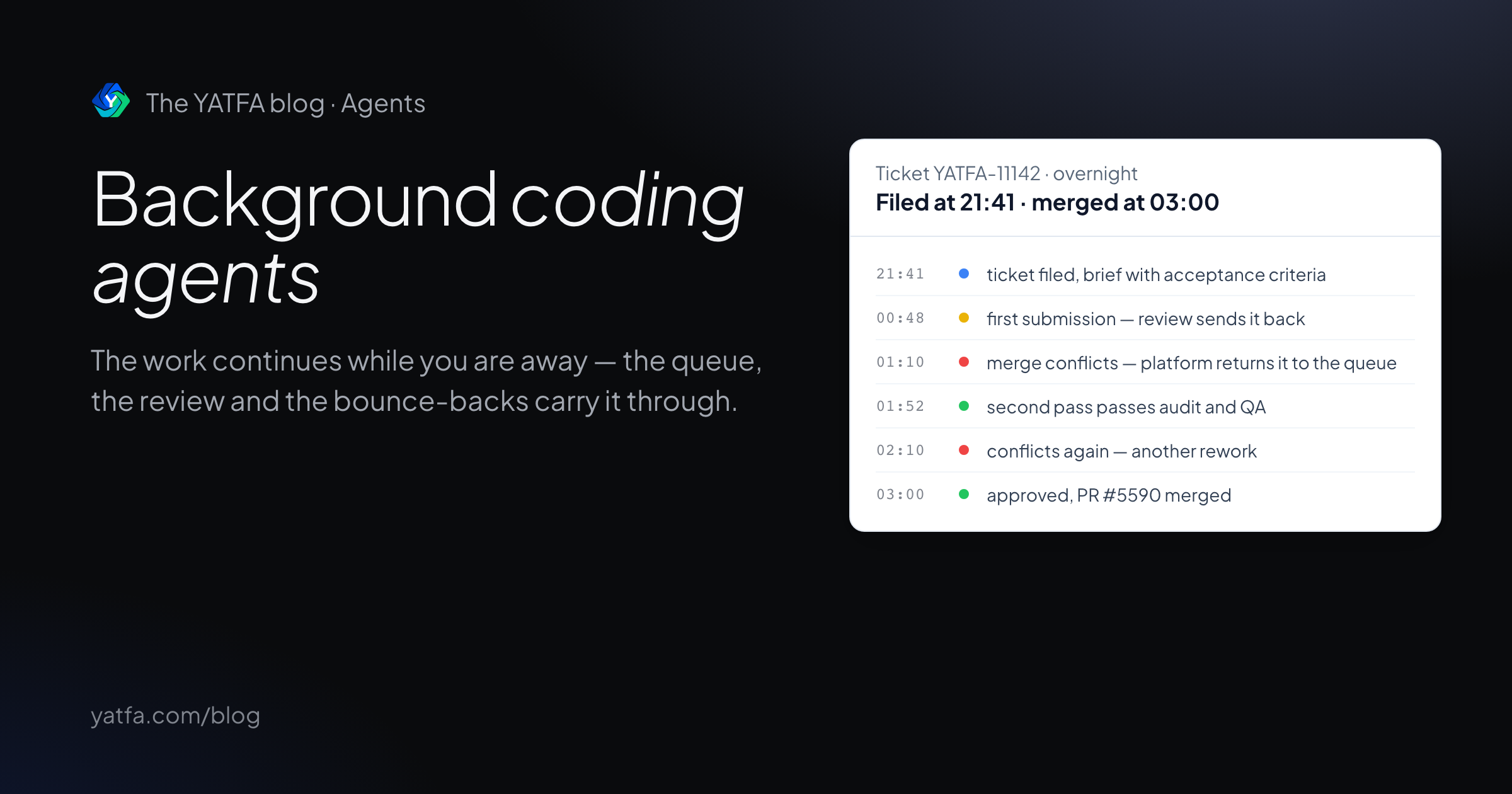
Background coding agents: how unattended work ships reviewed PRs
What happens between the task and the pull request, what the tools' own docs promise, and a ticket that passed review, bounced on merge conflicts, and merged overnight.
Read the article →